Welcome!
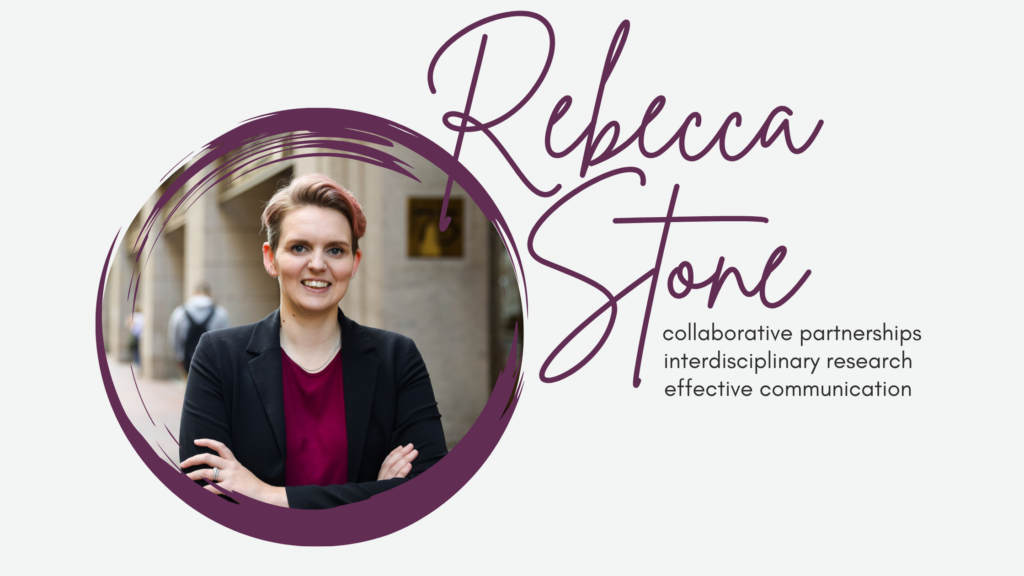
I’m Rebecca Stone, an interdisciplinary social scientist working at the intersection of criminal justice and public health to build stronger, safer communities — for everyone.
I have always been fascinated by human resilience and capacity for change. My primary research interest is how justice system-involved people transform their lives after incarceration. How do the stories they tell about their experiences support their successful reentry? What lessons can we all learn from the resilience and determination of people who turn their lives around — and how can we support those who are just starting their change journeys?
Much of my work has focused on gendered experiences of crime and criminal justice contact. I started this journey with an interest in where reproductive rights and criminal justice intersect, particularly the criminalization of some behaviors during pregnancy and historical efforts to surveil and control pregnant people. From this starting point, my research naturally expanded into gendered violence (particularly intimate partner violence), substance use, and gendered experiences in correctional systems.
I am passionate about doing interdisciplinary research that has real-world impact and advances equity and social justice. I am an alumna of the Robert Wood Johnson Foundation’s Interdisciplinary Research Leaders fellowship, a 3-year grant program through which my interdisciplinary team conducted community-engaged research and collaborated with community partners to develop and evaluate a cross-training curriculum for community-based victim advocates and peer recovery coaches.
My interest in storytelling extends to narratives about crime and their influence on public policy. For example, I have studied how police shootings are covered by online news sites, the impact of labeling and framing on public support for overdose prevention sites, and how people craft redemption narratives to resist stigmatization.
I became a researcher because I wanted to make our world a better place. I believe that research impact is best measured in the community, not through citations or journal impact factors. Community engagement and effective science communication are central to my work — they are, in my opinion, an ethical obligation. I enjoy designing effective presentations, writing for general audiences, and supporting early-career scholars in improving their communication skills to make sure that their important research reaches those positioned to do something with it.
Please use the navigation links to learn more about my research, teaching, and community engagement.