Like many (most?) PhDs, I did not receive any formal training in teaching during my graduate studies. The teaching preparation in my program, at the time, was pretty much trial-by-teaching. Once we had completed our non-dissertation coursework, we could teach a course as a graduate instructor. We were paired with a supervising professor, given a past syllabus for the course, and entrusted with 30 or more undergraduate students for a semester. I was fortunate that my supervising professor pointed me in the direction of McKeachie’s Teaching Tips and asked me some prompting questions about how I would manage the course — most of my peers got less than that.
Teaching well has always been deeply important to me, so in the few years since then I have sought out more information and have been fortunate to find online communities of skilled, generous educators. I owe so much to scholars like Raul Pacheco-Vega, Jess Calarco, the Teaching with a Sociological Lens group, and many others. I am also very grateful to other communities committed to open access — for example, the R community.
To start giving back, I have decided to make a lot of my teaching materials public so that other scholars can adapt and use them in their courses. I am starting with my 300-level undergraduate course Crime Mapping.

I developed this course in part through the Suffolk University Center for Teaching & Scholarly Excellence Course Design Institute, a 3-day workshop that helps instructors create and align their course goals, learning objectives, and assessments. I had picked up some of this information along the way, but had never taken the time to sit down and do “backwards design” so thoughtfully. I taught the course for the first time this semester (Spring 2019) and I can see how well this time was spent. Though there were difficult moments in the semester (teaching software skills + content can be tricky), I was pleasantly surprised by how well the whole course seemed to “hang together.” The assignments reliably called back to earlier content or relied on skills that students had just been taught, we covered everything I wanted to cover without feeling rushed, and everything just seemed to work.
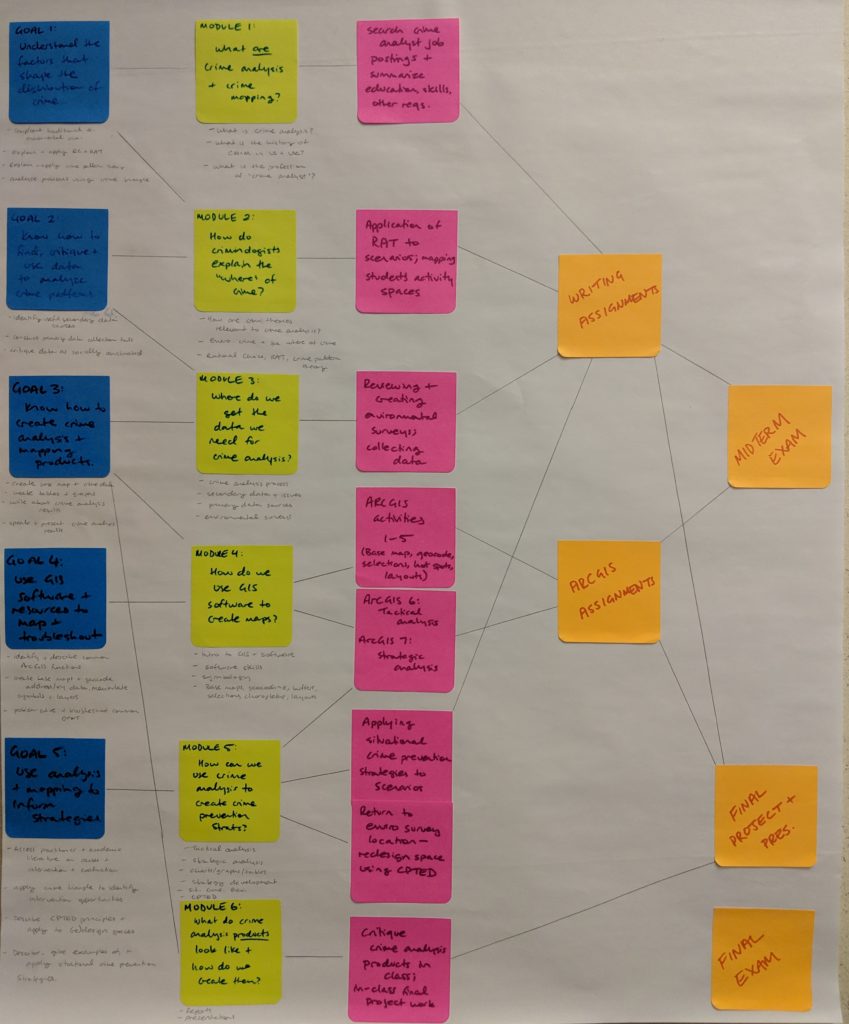
Below, I am providing lecture slides, in-class assignments, and ArcMap assignments for a 15-week semester. In the interest of making this course even more open-access, I will be working on converting the ArcGIS assignments into R assignments for instructors who do not have institutional access to ArcGIS. I currently assign Rachel Boba Santos’ Crime Analysis with Crime Mapping, 4th edition , as well as some supplemental readings like NIJ reports, scholarly articles, and resources from the POP Center.
DISCLAIMER: I am not a professional crime analyst and this course is not intended to provide formal crime analysis training. This is a 300-level elective course designed to introduce students to the scholarship of crime and place, and to teach students some basic GIS skills.
First, the course goals, learning objectives, and assessments I developed in the CDI:
Goal |
Learning Objective |
Assessment |
Upon successful completion of this course, students should… |
Upon successful completion of this course, students should be able to: |
Students will be assessed on these objectives through… |
Understand the environmental and social factors that shape the spatial distribution of crime. |
· Describe how environmental criminology differs from traditional criminology.· Explain and apply rational choice and routine activities theories of crime.· Explain and apply crime pattern theory and the idea of the “journey to crime.”· Analyze a given crime problem using the “crime triangle.” |
In-class and out-of-class writing assignmentsMidterm and final examsFinal project report |
Know how to find, critique, and use geospatial and sociopolitical data to build crime maps and analyze crime patterns. |
· Identify useful secondary data sources for crime analysis and mapping.· Construct primary data collection instruments.· Critique crime data as a socially constructed product and explain what this means for our understanding, analysis, and prevention of “crime.” |
In-class and out-of-class writing assignmentsMidterm and final examsFinal project report |
Know how to create informative, audience-specific crime analysis and mapping products. |
· Create a crime map by combining base map layers and crime data, using appropriate symbology and labeling.· Create informative tables and graphs for the visualization of crime data.· Write about crime analysis and mapping processes and results, targeted at specific audiences (e.g. the public vs. fellow practitioners).· Give spoken and visual presentations about crime analysis and mapping processes and results. |
In-class ArcGIS assignmentsMidterm and final examsFinal project report and presentation |
Understand how to use GIS software, internet search engines, and other available resources to create maps and troubleshoot common software problems. |
· Identify and describe common GIS functions for assembling and manipulating geospatial data and mapping products.· Create base maps and geocode social data, including adding data layers, moving and hiding layers, changing symbols and labels, and manipulating data.· Practice problem-solving and troubleshooting skills including using search engines and other resources to learn more about error messages and how to retrace steps to resolve errors. |
In-class ArcGIS assignmentsMidterm and final examsFinal project report |
Understand how crime analysis and mapping results connect to evidence-based crime prevention and reduction strategies. |
· Access practitioner and scholarly literature to research existing strategies and evaluation outcomes.· Apply the “crime triangle” or “problem analysis triangle” to a given crime problem to identify opportunities for intervention.· Describe the key principles of CPTED and apply them to design or redesign a public space to deter crime.· Describe, give examples of, and apply the five major situational crime prevention strategies. |
In-class and out-of-class writing assignmentsIn-class ArcGIS assignmentsMidterm and final examsFinal project report |
And the course schedule — click links for materials. The ArcGIS assignments reference a folder of map files and data, which you can download here (all map files and crime data were publicly available through Census TIGER or Analyze Boston, I just compiled them in one place for students): Merged 2017 and 2018 Crime Data – Shapefiles and Dr Stones Map Layers and Data.
Week |
Topic and Materials |
1 |
Topic: Intro to CourseComplete syllabus quizFinal Project and Presentation Assignment |
Topics: Introduction to Crime Analysis // The Role of Crime Analysis in PolicingBefore class: Read textbook chapters 1 & 3W1 Crime Analyst Job Search |
|
2 |
Topic: Environmental Theories of Crime IBefore class: Read textbook chapter 2 and “The Routine Activity Approach” (on Blackboard)Week 2.1 – Environmental Criminology and Routine Activities TheoryW2 Applying theories |
Topic: Environmental Theories of CrimeBefore class: Read “The geometry of crime and crime pattern theory” (on Blackboard)Week 2.2 – Geometry of Crime and Crime Pattern TheoryMapping activity spaces (see slides) |
|
3 |
Topic: Crime Analysis Process and DataBefore class: Read textbook chapters 4 & 5Week 3.1 – Crime Analysis Process and Data |
Topic: Environmental SurveysBefore class: Review the example environmental surveys on Blackboard and come prepared to discuss!Week 3.2 – Environmental Surveys and Direct ObservationCreating an environmental survey (see slides) |
|
4 |
Topic: The Past and Present of Crime MappingBefore class: Read NIJ Report Chapter 1 (on Blackboard)Week 4.1 – Past and Present of Crime Mapping |
Topic: ArcGIS Introduction and Data ManagementBefore class: Make sure you have your USB storage drive! Today we will start working with maps and you will need to save your work.W4 Introduction to ArcGIS |
|
5 |
Topic: Building base mapsBefore class: Read NIJ Report Chapter 2 (on Blackboard)In class: ArcGIS Exercise 1, building a base map of BostonW5 Building Your Base Map of Boston |
Topic: Symbols: Points, Lines, PolygonsBefore class: Review NIJ Report Chapter 2Week 5.2 – Points, Lines, and Polygons |
|
6 |
Topic: GeocodingBefore class: Read NIJ Report Chapter 4 (on Blackboard)Week 6.1 Geocoding |
In class: ArcGIS Exercise 2, adding ADDRFEAT layer to your Boston basemap and geocoding your crime dataW6 Adding Data |
|
7 |
Topic: Mapping Applications; Queries, Selections, and BuffersBefore class: Read Zgoba et al. (on Blackboard) – focus on method and results.Week 7.1 – Queries, Selections, and BuffersW7 Policy Analysis Writing Activity |
In class: ArcGIS Exercise 3, exploring the potential impact of sex offender residency restrictions in BostonW7 Using Mapping for Policy Analysis |
|
8 |
Topic: Choropleths and hot spot mapsIn class: ArcGIS Exercise 4, making shaded grid maps/choropleths using Boston crime dataW8 Creating Choropleths |
In class: MIDTERM EXAM |
|
9 |
Topic: Preparing Maps for SharingBefore class: Read NIJ Report chapter 5 (on Blackboard)In class: ArcGIS Exercise 5, turning your Boston maps into share-ready layoutsW9 Preparing Maps for Sharing |
Topic: Current and Future Issues for Crime AnalysisBefore class: Read textbook chapters 8 & 9In class: Pre-Crime documentaryW9 Pre-Crime Viewing Guide |
|
10 |
Topic: Tactical Crime Analysis I & IIBefore class: Read textbook chapters 10 & 11Week 10 Tactical Crime Analysis |
In class: ArcGIS 6, tactical analysis of a crime seriesW10 Tactical Crime Analysis |
|
11 |
Topic: Strategic Crime Analysis I & IIBefore class: Read textbook chapters 12, 13, 14In class: “Case of Places” and problem-oriented policingWeek 11 – Strategic AnalysisWeek 11 – 2012 Center for Evidence Based Crime Policy – Hot Spots Policing presentationWeek 11 – Case-Places-Guide |
In class: ArcGIS Exercise 7, strategic analysis and mapping chronic/long-term crime problemsW11 Strategic Crime Analysis – Hot Spots |
|
12 |
Topic: Strategy DevelopmentBefore class: Read “Situational Crime Prevention”and “Crime Prevention Through Environmental Design”(on Blackboard)Week 12 – Strategy DevelopmentW12 Situational Crime Prevention |
Before class: Review your “Environmental Survey” results.W12 Strategy Development |
|
13 |
Before class: Read textbook chapter 15In class: No class meeting – online lesson on Blackboard!Week 13 – Mapping Products |
Topic: Effective presentation: Reports and PowerPointIn class: Final project preparation time. |
|
14 |
Project Presentations |
Project Presentations |
|
15 |
Final exam review |